• Skip to main content

Newton Schools

School Consultants in India

  • About Us
  • New Age Schools
    • The Need
    • The Difference
    • Creating new schools
  • Services
    • School Consultants
    • Detailed Project Report
    • School Design
      • Design Planning
      • Site Selection and Evaluation
      • Architectural Design & Drawings
    • School Construction
      • Civil Construction
      • Interiors Execution
      • Turnkey Project Management
      • School Renovation
    • School Operations
      • Outsourced School Operations
      • Safety & Security
      • School Supplies
      • Day to Day Operations
      • Recruitment & Placement
      • Training & Development
      • Workshops & Seminars
    • Change Management
      • Change Strategy
      • Gap Analysis
    • Marketing for Schools
      • School Admissions
      • Advertising & Marketing
      • Branding & Rebranding
      • PR & Media Coverage
    • International Collaboration
  • Blog
  • Projects
  • Contact Us
You are here: Home / Blog Template

Blog Template

10 Jun 2021 |

Setting up a new school?

Are you setting up a new school?

setting-up-a-schoolAre you creating a new school in India? Do you have land on which you plan to set up a new school? Or maybe you want to buy land to set up your new school? Do you have an existing school and are now planning to create another new school?  Before you embark on any one of these, do read this article – not only will it help save investments but also ensure that you create a school that will be successful.

Creating a new private school is a big project – it involves significant infrastructure investments and upfront costs, while the return on investment comes over a long period of time. Agreed that the returns are good in the long run, but they are not guaranteed for all schools. As competition increases and a sufficient number of schools have already been created, the chances that another one will make good return on investment is reducing. These are some of the points to consider before starting a new school, that can help guide you decisions:

Does your town or city need one more school?

A brief survey of your town or city will tell you if there is a dearth of schools there. In our experience, A, B and C class cities and towns in India already have sufficient schools and not all of them are able to achieve 100% occupancy.  So why would you want to create another and add to the chaos?

Our surveys also show that most schools in these places are similar in nature – they have a standard classroom based learning environment that delivers the CBSE curriculum with some additional extra curricular activities. Progressive, younger and educated parents are looking for more – international curriculum, experiential learning, exposure and a truly 21st century learning environment. If your town or city doesn’t have many schools offering all this, that is the kind of school you should create, so it stands apart from the crowd.

Do you have sufficient funds to create a good school?

schoolGone are the days when schools could be started by creating a small building on a large piece of land, and expanded slowly with the fees being received from students. Instead, schools are now being created on smaller pieces of land to reduce investments and are vertically built to add capacity. They are also constructed with a lot of facilities to showcase at launch from a marketing perspective. All this requires significant upfront investment. It is wiser to plan the investment, the phases in which it would be done, the sources of the investment and then start the project. You would not want to be in a situation with an incomplete school and exhausted funds.

Patient capital and patience:

The capital investment in schools can span 4 to 5 years or longer depending on the school project plans. The return of the investment can further take anywhere between 4 -10 years. As the investments are locked in during this time, we term it patient capital. In the first few years of the operations of the school, the revenue might be lower than expenses. Despite this, expenses cannot be curtailed as that would compromise the quality of education being delivered. Every investor’s patience is tested, the ones who can continually invest and maintain the quality of operations are significantly rewarded.

Planning an innovative, new school:

Once all of the above are sorted, you need to plan an innovative new school. Consider international curriculum like the International Baccalaureate or the Cambridge Assessment International Education. Implement experiential learning or problem based learning. Look at strategies for delivering 21st century education. Accordingly, design the building and infrastructure to deliver your choices in a planned way. Keep in mind that the building should be flexible enough to incorporate future needs. Invest in essential services – of a school and educational consultant who can guide and keep costs in control. 

With all of this, you should have a good future-ready school that becomes that city or town’s top choice in a matter of a few years. In our experience, all the investments done can be recouped back in 5 to 10 years, and thereafter, it can offer an additional 30-40% ROI, year after year.

Newton Schools has completed several greenfield school projects.

For all inquiries regarding setting up a new school, please contact us.


Filed Under: Designing Schools, School Consultants | Tagged With: create new school, new school, setup new school

4 Jun 2021 |

School Consultants in India

School Consultants in India

Are school consultants necessary for school projects? What is the role of a school consultant in India? In this post, we explore various scenarios in which school consultants can add value. Let’s dive in.

Who needs a school consultant?

These are some of the main reasons for bringing a school consultant on board:

  1. If you are an entrepreneur setting up a new school and making an investment into land and building, you should definitely hire a school consultant to walk with you through the project. They can guide you on making a better school, one that will withstand the changes over time and still deliver an amazing experience for students.
  2. If you have an existing school and are looking at upgrading the infrastructure or the quality of the school, school consultants can add value to the change process.
  3. If you have an existing school that is doing well, they can do an audit and give you an independent perspective of where you stand and what could be improved.

School consultants are usually brought on board by the owners, management or board of governors of a school. While they may work with school leaders, staff, students and parents, they usually submit the required reports to the school owners so that appropriate plans can be drawn to implement changes.

What are the types of school consultants in India?

There are numerous school consultants in India and they can be broadly categorised into the following:

  1. Academic Consultants:  Consultancies setup by ex-Principals or teachers usually focus on the academic side of the school – they work on defining the curriculum, teacher training, recruitment’s etc. 
  2. Project Consultants:  These are school consultants who have experience in launching new schools and creating infrastructure for school projects. Project consultants often define the financial projections of the school, plan the kind of school to be created and help in getting the infrastructure ready for operations. They are usually recruited at the beginning of a new project and their roles end once the school is ready for launch. 
  3. General Consultants: Consultants who cannot be defined as educational or project consultants fall in this category. They have expertise in school operations and management, and can act as a bridge between school owners and everyday operations of schools.  

Over the years, Newton Schools has provided services for all the above 3 functions to various schools. While the core team at Newton Schools has expertise in School Project Consultancy, we have team members who also service the other functions. 

There are other kinds of educational consultants providing services for enrolling students in universities abroad, only recruitment services etc. They are not relevant from the perspective being considered here.

What are the benefits of a school consultant?

school-consultantsAs a school owner or management team member, you are involved in creating or operating a particular school or group of schools. You would need perspective on each decision, that is not clouded by your current thinking and operations. Experienced school consultants would have worked with multiple school projects and gained a variety of experience. They bring this value to the table and ensure your school benefits.  Bringing on board an experience  school consultant benefits in the following additional ways:
  1. Cost Savings: Experienced school consultants can help your school save costs, they know how to avail services at reasonable prices and know the source of good service providers. 
  2. Avoid Mistakes: Many schools have tried various things and made several mistakes and learnt from them. You can avoid those mistakes, saving time and money, by bringing in experienced school consultants. 
  3. Wider Vision: While you may have a great vision and a plan for your school, it helps to validate the same by discussing it with school consultants. Often, the vision and the plan are enhanced by the inputs provided by the consultants. 
  4. Better execution: This is especially true for new schools that are to be constructed. School consultants can ensure the whole project is executed well, avoiding delays and mistakes that have significant costs. 

How much do school consultants charge?

While this answer isn’t applicable on all, some of the ways in which school consultants charge are:

    1. Project Cost:  School consultants offer a proposal for executing a particular project and define a fixed cost for the project. In such proposals, the time consumed by the consultants or the time span of the project is defined. This is usually done for smaller, shorter projects. 
    2. Retainers:  Most school consultants offer a retainer service, where they contribute a fixed amount of time per month to the school. Their role during that time is defined. Retainers help schools in getting maximum inputs from consultants at a fixed cost over a long period of time. 
    3. Project Percentage: This method of charging is usually applied by school consultants for new school projects, where it is expected that the project consultants will help save costs. A defined percentage of the entire project value is charged as a fee by the school consultants and their role is defined to ensure the project proceeds smoothly, within a budget. 
    4. Time Basis: There are consultants who charge by the hour. They usually have a minimum number of hours defined per week or per month and the role is also accordingly limited.

In most of the above, any travel and outstation stay of a consultant is billed to the school. If the consultancy is a firm with additional manpower supporting the main school consultants, the charges are accordingly billed to include services of all the people involved.  The charges of all consultancy services vary, based on their expertise level, the services they provide and the specific requirements of your school.

For additional information or to talk to us at Newton Schools, please contact us.


Filed Under: School Consultants | Tagged With: school consultancy, school consultants, school consultants in India

24 Dec 2020 |

Furniture for today’s classroom

Today’s learning environments are evolving to keep up with the changing environment and technological advancements. All the new-age schools require classrooms that foster collaboration and creativity among learners. 

More and more schools are integrating technology in the classroom but this also means classrooms must now be equipped with specialized furniture to accommodate the changes. 

Here are a few furniture ideas for today’s classroom that will provide an ideal learning environment for learners to thrive and grow. 

Collaborative & Flexible Furniture

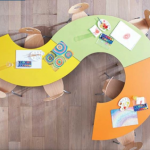
school furnitureTraditional classrooms are equipped with static desks and chairs all facing the same direction. There is also a blackboard placed behind the teacher’s desk. Classrooms with this type of layout aren’t ideal for group activities. It makes it tedious and time-consuming to arrange desks and chairs for group interactions. 

Today, collaboration is crucial in a learning environment. In the future, when learners apply for jobs they’ll be expected to be able to work in variable teams. Working collaboratively in school will help a child interact, communicate, and find solutions to problems while working with others. 

comfortable seatingBy making them modular, the desks can be used for variable sized groups and for multiple applications. Collaborative furniture such as light movable desks, desks, and chairs with wheels, integrated with power outlets, and round tables.  Schools can implement modular adjustable desks with comfortable seating. This will create learning experiences suited to their tasks or projects. 

Tech Integrated Furniture

School curriculums are changing to adapt to the changing technological needs. Due to the pandemic, remote learning has proven to be accessible for all learners. Now, through laptops/tablets/computers classes can be accessed and through interactive software, homework can be submitted. 

To prepare learners for the future, classrooms need to be technologically integrated. Tech-integrated furniture will help learners explore new avenues of learning with a better engagement of learners. Multimedia tables, desks with power outlets, etc can easily integrate with tech learning solutions. Storage cupboards with charging docks.

Engaging Furniture for Learners

When learners spend most of their time sitting on static desks and chairs in the classroom, chances are that they have very little interaction and engagement. But studies have shown that new-age schools that have adopted flexible furniture, have shown a positive impact on learners’ overall engagement, creativity, and motivation.  Learners need classrooms that inspire them, help them express, share ideas, and be comfortable enough to stay attentive throughout the day.

Engaging furniture such as soft seating, cushions, mobile chairs, and niche seating creates, portable boards and storage units, can make the classroom experience more engaging.

Filed Under: Designing Schools, Future Schools | Tagged With: Classroom design, modern school furniture, new school furniture, school design, school furniture

1 Dec 2020 |

Canteen Conversations: Acoustic Solutions for Schools

Canteen Conversations: Acoustic Solutions for SchoolsStudents often look forward to their break-time in school because of various reasons. Firstly, as they can meet their friends across various grades and chat over their favorite cartoon/movie episodes and also fill their tummies with some amazing food.



Break time also acts like beating the monotony for them. As they are other times much involved in academic learning.

The same is the case with the teachers. In their break time, they too require a rejuvenating experience.

Studies have also shown that to savor food completely & for better digestion, one’s five senses must be completely present while having food, namely:

  • Sight
  • Smell
  • Touch
  • Taste
  • Sound

Notably, Sound also is a very important sense while savoring a meal to the fullest. From the sound of breaking bread to chewing, swallowing, etc. contributes to this sense. These may be also termed as natural sounds while eating. The problem arises when the natural sounds are suppressed by the unnatural sounds, which is in turn the noise created in the room by poor acoustic treatment.

The underlying question still remains- Are students & teachers really able to get the best out of this break time?Canteen Conversations: Acoustic Solutions for Schools

In most cases, the answer sadly remains No. The reason being canteens/cafeterias have high sound pressure levels. The major factors that contribute to the noise are:

  • A large no of students talking with each other
  • Cutlery/tiffin/table/chair noise
  • Fan/AC noise etc

As far as it goes, one may have very little control over the factors that contribute to the noise. But surely the environment can be altered in a way that will reduce the sound pressure level. Most of the time canteen spaces are not prioritized in having good acoustics. Whereas it is one such space that needs to be really thought well off when it comes to acoustics.

The solution is not that complex – Install complete wall-to-wall high absorbing Class A acoustic ceilings and cladding at least 20% of the floor area with acoustic wall panels on any of the nearest wall surfaces, if feasible. Class A sound-absorbing systems will absorb about 90% of the sound that would hit on the material, thereby ensuring reduced echo and noise.

The results of which will be:

  • Lower stress levels in teachers/students
  • Higher productivity
  • Enjoying the meal without high background noise

There is less weightage provided to acoustics, currently in the Indian market. In most cases, stakeholders aren’t aware that there is a solution to the problem of noise and it isn’t too complicated either. While auditoriums, classrooms, and other areas have their own importance, the canteen/ cafeteria spaces cannot be neglected for sure!

The high NRC acoustic solutions by Ecophon can help transform a noisy room into a much calmer one. Acoustics contribute to a better working environment where people work and communicate. 

To know more log on to: –

www.ecophon.in


Harshal Kolwankar
(Concept Development Manager)
Ecophon Group         

About Ecophon Group:

Ecophon Group develops, manufactures, and markets acoustic products and systems for ceilings and walls. Used all over the world, they meet the growing demand for good acoustics with a focus on offices, education, and health care premises. Ecophon contributes to a better working environment— wherever people work and communicate. The company is based in Sweden & it’s a part of the global Saint-Gobain.
Group www.ecophon.in                                                                                                                                           

Filed Under: Designing Schools | Tagged With: Acoustics, Classroom design, Sound

30 Nov 2020 |

How to make social distancing work in schools?

We all are waiting for the schools to reopen. It has not only been tough for learners but also for the teachers to conduct classes online during this pandemic. We are still a long way off from the normalcy of pre covid times. We have to make it our way of life. 

Shared below are some notes on making social distancing work in your school?

Prepare teachers, staff, parents, and students

All groups need to be prepared for the school reopening post-COVID. These have been unprecedented times, restarting needs understanding of everyone’s frame of mind. A survey with each of the groups on their readiness to restart school will create a framework for future interactions and also sensitize the school on their anxieties. 

A representative working group of parents, teachers, and staff should be set up for planning & execution of the new protocols in school. A health and sanitization consultant may also be brought on board.

The group should undergo a risk assessment exercise. These sessions must plan the structure of functioning, classroom arrangement, social distancing, circulars, and policies on COVID guidelines for ensuring safety and hygiene at school. 

Teachers are expected to deal with learning recovery and, student’s mental and psychosocial needs. The school counselor must also help the teachers plan the student engagement. Minimize any activity that requires physical contact or sharing of resources. Train teachers to help children understand the social distancing guidelines and how to ensure their safety. This communication must also be planned with parents & students.

The group must identify the spaces that are an absolute must for the functioning of the school. Spaces, where social distancing is difficult to implement, must be kept closed/ alternatives identified.

People Driven Learning

How to make social distancing work in schools?

Children gain a lot from being in school, with their interactions with teachers and peers. While technology has served us well to plan learning interactions, we must also leverage it to allow greater physical interactions. We must ensure that this technology is available in all classrooms. Children should be able to attend class discussions from the home virtually or physically in classrooms. The scheduling or the school roster should be managed to allow social distancing between those present in school. Blended classrooms that have been talked about lately gain more relevance to create “personalized learning”.

Designated Zones on Designated Days

Children must have access to as many spaces in the school as possible. A coding mechanism may be implemented to create designated zones for children for various days of the week. This way groups that will go to the spaces will be predesignated. And the sanitization team will be able to clean the spaces after use by each group.

Communicate with Parents

Parents must be assured of their ward’s safety at school. The working group’s recommendations implemented in school must be shared with the parents, they need to be on board for the reopening. They must understand the tasks from them. Unless the parents support this it will be difficult to get children to follow. The processes should be implemented to create a safe space and avoid any fear-based messaging, to be sensitive to all.

While there is awareness of hygiene, safety, and social distancing, implementing it in a school space means that there have to be greater awareness rules at school. The use of masks, sanitizers, and hand wash should be facilitated by their easy access in school. In spite of these measures, there has to be ownership where parents must monitor their children, the children and staff must also self-assess. It is only when there is this acknowledgment can such a system work. The communication then becomes important.

Staggering Hours / Days at School

Staggering hours, the students’ arrival at school can be planned in a way to prevent overlap with the next slot. This will give enough time to implement cleaning protocols and assembly of large groups. Plan transport timings or ask parents to pick and drop their kids to maintain safety. With the time slot, you have to plan the seating arrangements as a measure for social distancing. When technology is leveraged in school then the entire class does not need to be in on the same day.

School Transport

Parents might prefer to drop their children at school on their own. Whenever it is possible to restart school a spaced seating arrangement to maintain social distance must be implemented. 

As all children do not attend the class on the same day, the spacing will be possible in school transport. The transports must be sanitized after every use. 

Cleaning, disinfection, and sanitization

Cleaning removes impurities from the surfaces while the disinfection process uses chemicals to kill germs that might be present on the surfaces and sanitization works either by cleaning or disinfection and lowers the risk of spreading infection. Timely sanitization at school will help lower the risk of spreading infection. 

A variety of sanitization procedures must be implemented as different areas/surfaces may need different procedures.

Maintain Hygiene and Ensure Safety 

Wearing masks should be mandatory for everyone on the premises. Everyone should be sensitized on the kind of masks to wear, to wear them properly, and to use fresh masks each day. Everyone should also be encouraged to carry spare masks and to change them in case any gets dirty. Also, they must not share or switch masks.

The school may implement entry protocols for temperature and oxygen saturation, at the same time there must be a safe & comfortable isolation zone for students/staff who show symptoms that warrant isolation/ non-entry to the school.

Use Poster and signages 

How to make social distancing work in schools?

Use posters and signages to display the safety measures for everyone at school with language and visual medium that is suited to the children. Visual information is more easily grasped.

The goal of the exercise is to restart the learning among the children in a healthy and safe way. Processes often fail because of the human element, getting all stakeholders on board is very important for this to succeed. And all variations must be documented so that there is a clear understanding of the reasons for each failure. These will enhance the ability to prevent them the next time and to improve the processes.

Filed Under: Designing Schools, Future Schools | Tagged With: school reopening plan, social distancing, social distancing at school

  • « Go to Previous Page
  • Page 1
  • Interim pages omitted …
  • Page 3
  • Page 4
  • Page 5
  • Page 6
  • Page 7
  • Interim pages omitted …
  • Page 9
  • Go to Next Page »

· Copyright © 2026 · NEWTON SCHOOLS Our Businesses: · NEWTON SERVICES