How do you create a preschool that delivers what parents want? This question lead us to look into several aspects of creating a preschool.
Walking around any residential area in any city in India, one is able to spot at least half a dozen pre-schools or billboards advertising preschools. How well are they able to deliver what parents need? And how well do they understand their roles as the bridge to primary education? And most importantly, how well are they able to deliver on the promises they make.
What do parents want?
What parents want out of preschools is very different from what they want in a regular school. Their focus is more on child safety, hygiene, social interaction and play.
- Take care of my children
- My child should feel safe
- My child should want to go to school
- Children should be engaged
- Children should be engaged with several different activities
- Learn how to appreciate everything
- Children should want to learn
- Children should be excited about their day and school
- Children should be happy to tell us about their day in school
- Want a safe environment to grow
- Encourage my child to be curious, to learn
- Build the confidence of my children
- Instil curiosity and want to learn
- To be able to ask questions
- To be able to think independently
- My child should be able to express himself well
- My child should make friends
- Children should learn how to interact with others
- My child should learn how to play with others
- Help children develop emotionally and socially
- Help my child express himself
- Fun, clean safe
- Welcoming and an open mindset to make children comfortable to foster creativity!
- Making children learn and have a POV on the alphabet
- Safety first (sending my child to someone with trust), teachers should be friendly with us and have to be guardian to the kids
- Basic entertainment without screens like dance, playing, little bit learning
- Fun and social interaction
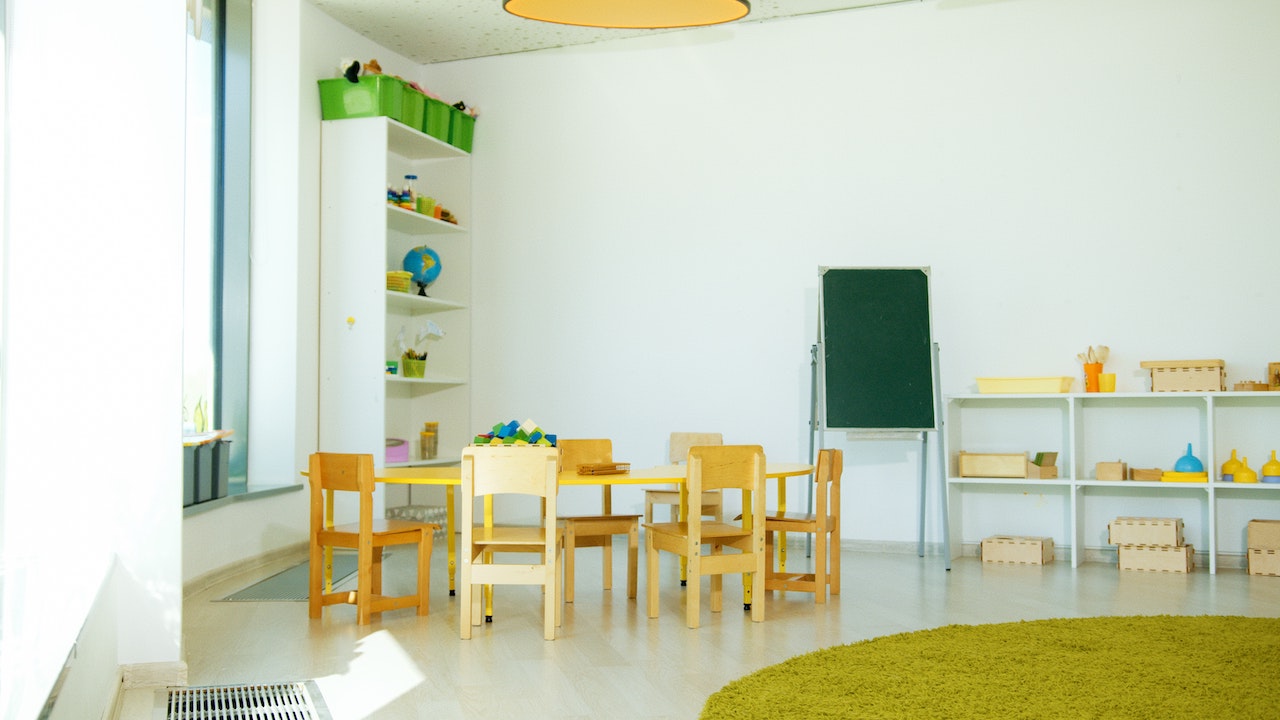 Over the years we have seen multiple versions of such statements researching and understanding parents looking for a preschool to enroll their children. And, of course we have spent several years creating schools that promise these and deliver them. It is a layered understanding of creating a right balance between target parent requirements and the needs of a 21st century education.
At the outset parents will look for safety of their child and the convenience of the school location. From that starting point the rest of the statements become differentiating factors in determining the right school for their children. This differentiation between schools is often layered with how the schools speak about themselves, what the parents see and what they hear from other parents about the school.
Some of these observations are conscious, others subconscious.
- Are the spaces safely designed? Are they welcoming, are they engaging? Is there diversity?
- Who is in the school? Do the teachers and the head of the school inspire confidence in their ability to take care of my child?
- How does the preschool acknowledge my child is special? Is the school geared to give adequate attention and care to my child
What makes the preschool better suited to the needs of each child?
It is not possible to address all individual needs of parents as often they can be contradictory.
E.g. Some parents will want a digital element in the school others will want nothing to do with it
Importance of research
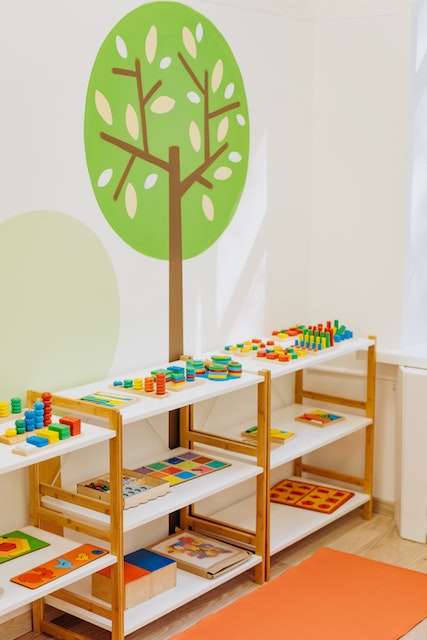 When we partner with clients, our projects often involve local area research. We delve into requirements such as these and identify the higher level needs of parents. Only by understanding where the requirements of the parents are coming from can one seek to fulfil them effectively. And as a result serve the needs of the larger target group. Often there are instances where parents need help in managing the behaviour of their children and this help comes from the environment set up in the school.
New entrepreneurs often identify one set of parents and build a school around their needs. Sometimes it is the needs they missed when they sought a preschool for their children. In other instances it is the perceptions of their peer group. It runs the risk of being a limited view. When preschool-teachers set up the school, they may have a great academic plan but will miss out on the administrative or operational efficiencies. Each of these runs the risk of resulting in a siloed view of the needs of the market.
We have created such an appropriate environment across diverse geographies. We are quickly able to understand the root solution that will address diverse needs of parents. We are also able to define the linkages between these solutions and the school brand, vision and mission.
Our approach is to help the entrepreneur articulate their vision of the school and map out how best it suits the market requirements. We then draw inspirations from developments in the sector across the world. For our projects we need regular interactions with architects, designers, academic counsellors, school founders, teachers, parents and vendors. This means that we have a continuously updated list of vendors and school needs. We also have a historical perspective on what worked and what didn’t. That allows us to deliver insights quickly.
A school where a child is safe, happy, socially comfortable and learning/developing according to their age. The ability to deliver this, to deliver the high level requirements of the target parents and to pull the triggers will enable those parents to see value in the school promise. That will result in the success of the school.
 Over the years, Newton Schools has provided services as project consultants in developing the school concept, marketing strategy and the financial projections. Such engagements begin at the concept stage when the school is an idea and perhaps even the land has not been acquired. We have also worked in already initiated projects as academic/management consultants defining the curriculum, the teacher training and recruitments. And in other projects as management consultants building a bridge between school owners and everyday operations of schools.
Post to follow: Approaches to early years education.
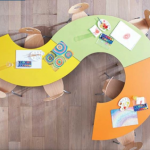 Traditional classrooms are equipped with static desks and chairs all facing the same direction. There is also a blackboard placed behind the teacher’s desk. Classrooms with this type of layout aren’t ideal for group activities. It makes it tedious and time-consuming to arrange desks and chairs for group interactions.
  By making them modular, the desks can be used for variable sized groups and for multiple applications.
 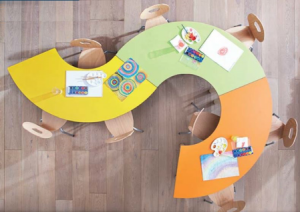 While setting up a new school not enough effort is devoted to the selection of appropriate furniture. One suited to design & function. In a traditional school, it consists of a standard set of desks in a limited set of sizes. Progressive investors, who value open classrooms, understand the value of planned furniture. The lack of choices hampers their decision.
 Open classrooms serve as multi use spaces. They are expandable to create larger areas through movable partitions and glass walls. They suit traditional lecture style classrooms and modern group activities. Likewise furniture should also be easily movable. Some of it should be movable by the children themselves. Modular so that you can add more without any aesthetic changes. E.g. it should be possible to arrange the desks for a group discussion or for individual work.