Today’s learning environments are evolving to keep up with the changing environment and technological advancements. All the new-age schools require classrooms that foster collaboration and creativity among learners.
More and more schools are integrating technology in the classroom but this also means classrooms must now be equipped with specialized furniture to accommodate the changes.
Here are a few furniture ideas for today’s classroom that will provide an ideal learning environment for learners to thrive and grow.
Collaborative & Flexible Furniture
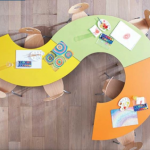 Traditional classrooms are equipped with static desks and chairs all facing the same direction. There is also a blackboard placed behind the teacher’s desk. Classrooms with this type of layout aren’t ideal for group activities. It makes it tedious and time-consuming to arrange desks and chairs for group interactions.
Today, collaboration is crucial in a learning environment. In the future, when learners apply for jobs they’ll be expected to be able to work in variable teams. Working collaboratively in school will help a child interact, communicate, and find solutions to problems while working with others.
 By making them modular, the desks can be used for variable sized groups and for multiple applications. Collaborative furniture such as light movable desks, desks, and chairs with wheels, integrated with power outlets, and round tables. Schools can implement modular adjustable desks with comfortable seating. This will create learning experiences suited to their tasks or projects.
Tech Integrated Furniture
School curriculums are changing to adapt to the changing technological needs. Due to the pandemic, remote learning has proven to be accessible for all learners. Now, through laptops/tablets/computers classes can be accessed and through interactive software, homework can be submitted.
To prepare learners for the future, classrooms need to be technologically integrated. Tech-integrated furniture will help learners explore new avenues of learning with a better engagement of learners. Multimedia tables, desks with power outlets, etc can easily integrate with tech learning solutions. Storage cupboards with charging docks.
Engaging Furniture for Learners
When learners spend most of their time sitting on static desks and chairs in the classroom, chances are that they have very little interaction and engagement. But studies have shown that new-age schools that have adopted flexible furniture, have shown a positive impact on learners’ overall engagement, creativity, and motivation. Learners need classrooms that inspire them, help them express, share ideas, and be comfortable enough to stay attentive throughout the day.
Engaging furniture such as soft seating, cushions, mobile chairs, and niche seating creates, portable boards and storage units, can make the classroom experience more engaging.
 Students often look forward to their break-time in school because of various reasons. Firstly, as they can meet their friends across various grades and chat over their favorite cartoon/movie episodes and also fill their tummies with some amazing food.
 When we speak, we push air from our lungs through the neck via the vocal cords, which in turn vibrate and create sound. The sound continues on via the nasal cavity and oral cavity, creating sound waves that are released into the room. These sound waves are received by someone’s ears via the outer ear to the inner ear, where they are converted into electrical impulses. These continue to the brain, where the receiver hears. What is heard is not just a voice, however, but also what the room does to the voice of the sender. If the speech is interesting, the receiver hopefully starts listening, and if the acoustical conditions around the speaker are good, you are likely to remember more of what is said.
 Teachers and students have three wishes in relation to sound and noise in classrooms. They want: