• Skip to main content

Newton Schools

School Consultants in India

  • About Us
  • New Age Schools
    • The Need
    • The Difference
    • Creating new schools
  • Services
    • School Consultants
    • Detailed Project Report
    • School Design
      • Design Planning
      • Site Selection and Evaluation
      • Architectural Design & Drawings
    • School Construction
      • Civil Construction
      • Interiors Execution
      • Turnkey Project Management
      • School Renovation
    • School Operations
      • Outsourced School Operations
      • Safety & Security
      • School Supplies
      • Day to Day Operations
      • Recruitment & Placement
      • Training & Development
      • Workshops & Seminars
    • Change Management
      • Change Strategy
      • Gap Analysis
    • Marketing for Schools
      • School Admissions
      • Advertising & Marketing
      • Branding & Rebranding
      • PR & Media Coverage
    • International Collaboration
  • Blog
  • Projects
  • Contact Us
You are here: Home / Archives for Blog

Blog

10 Jun 2019 |

Designing active play areas in schools

Across the world, physical activity among children is decreasing. Indian cities in particular do not promote active lifestyles because of the high population density, infrastructure limitations, pollution and the climate.
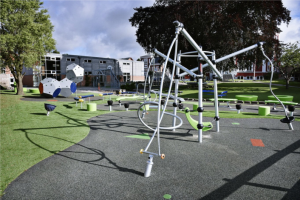
kompan-playgroundPhysical activity is an important contributor to the health of a community. In fact, physical inactivity is identified by the WHO as the fourth leading risk factor for global mortality with major implications for the prevalence of noncommunicable diseases (NCDs) and the general health of the population. Often one fails to realise the benefits of active living, especially when increasing work demands make it difficult to take time out for exercise. By the time one is forced to set that time aside the lifestyle related ailments have already surfaced. At such a point a lot of effort is required to change one’s lifestyle and make physical activity part of our regimen. Habits are acquired over time, perhaps best inculcated early in life. Urban environments in India  are generally ill suited to facilitate such healthy lifestyles. For someone to be naturally inclined towards active living, such habits need to be acquired early on in life.

Across the world, physical activity among children is decreasing. Indian cities in particular do not promote active lifestyles because of the high population density, infrastructure limitations, pollution and the climate. WHO recommends a minimum of one hour a day of moderate to vigorous physical activity for children and young people. This is important to stay physically fit and to avoid lifestyle diseases such as diabetes and cardiovascular ones. By enabling children to enjoy active lifestyles, through play, we promote healthy living among them. Opportunities and right to play will ensure they grow up to be healthy adults.

Children enjoy being active, all they require are well-equipped play areas accessible at the right place. Anyone who has seen a toddler explore a jungle gym will understand how free play activity enhances skill development among children. They push their limits all the while observing others do the same. All this without competition or instruction. And children learn to play with each other, building social skills.

Children are active without structured physical training sessions. They are able to explore their environment, their creativity and their social skills. Research has shown that play can lead to physical, social, emotional and cognitive benefits for children

The UN’s  Convention on the Rights of the Child states that children have the right to play. Schools play an integral role in creating the atmosphere that promotes active play among children. To meet their commitment towards child developmental milestones, schools must make a concerted effort to provide such an environment.

Global Recommendations on Physical Activity for Health (WHO)

https://www.who.int/dietphysicalactivity/global-PA-recs-2010.pdf


Age group: 5–17 years old

For children and young people of this age group physical activity includes play, games, sports, transportation, recreation, physical education or planned exercise, in the context of family, school, and community activities. In order to improve cardiorespiratory and muscular fitness, bone health, cardiovascular and metabolic health biomarkers and reduced symptoms of anxiety and depression, the following are recommended:


1. Children and young people aged 5–17 years old should accumulate at least 60 minutes  of moderate- to vigorous-intensity physical activity daily.


2. Physical activity of amounts greater than 60 minutes daily will provide additional health benefits.


3. Most of daily physical activity should be aerobic. Vigorous-intensity activities should be incorporated, including those that strengthen muscle and bone,  at least 3 times per week.

Nature of play areas recommended:

Accessible

We recommend having defined play areas in locations easily accessible by the target children’s group. They should be easily able to access it in recess times, or other free times. The school timetable should be designed to allow children to spend time in these areas. Off course, other considerations that need to be factored in are the climatic conditions, too much sun in the summer? Sufficient shaded areas, for it to be a viable playing area.

Age appropriate

For each developmental stage, activities that contribute to the development of physical, emotional, social, cognitive and creative skills in children vary. While formal sports are a good way to inculcate such learning, it is often through unstructured play that some early developmental skills are honed by children. Free play areas where children expend energy and develop motor skills, build bone & muscle strength and cardio are some examples of play contributing to development in early education. Defined areas must be age appropriate with a varied range of activities to meet the requirements of each age group.

Children learn to play together, interact with their peers, develop teamwork, competitiveness empathy and more through play activities. The joy of free play is a fundamental experience to a child. Schools must respect this by creating appropriate spaces.

Community

For children to desire to play, the play area needs to be designed to draw out their interests. If the activities in the play area are easy, the children will soon master them and get bored with them. Activities that are too difficult will lead them to give up and look for something else. For each age group, there need to be multi-play areas that require a variety of challenges calibrated to be progressively more difficult.

 “Well designed playgrounds can provide stimulus to social, emotional, cognitive and creative growth. This besides the physical growth, of course”,says Vinay Bhatt, Business Development Director of Kompan, the world’s largest play equipment manufacturers.

The design of the space needs a strong creative element, something that inspires children to devise games of their own, to allow them to play individually and together, to create that urge to spend more time.

Themed play areas that are also physically challenging can be designed to require active thought and collaboration. Perhaps an area that blends in with its surroundings, is bright and colourful and builds a sense of community.

Quality & Safety

At no point must one compromise on the quality of the play area. This means creating a robust product that is designed to withstand the climate and regular use. While it must be durable, it must also have a regular service and maintenance schedule.

There is increasing awareness in creating child-friendly school environments, the same needs to be applied in designing the play areas. For example, in a basic fun station, in addition to the movable parts being well anchored, and no sharp edges, care must be taken that all materials are non-toxic.

We are trying to create a healthy system for our children so sustainability and eco-friendliness of the process and product should also be in our consideration set. After all, these efforts will lead to a better world for our children.

Filed Under: Designing Schools, Future Schools | Tagged With: kompan, lets play, play areas in schools, play equipment, school playgrounds

26 Apr 2019 |

Brand Promise of a School

“Chalkboards and good teachers are all that one needs”, is no longer a winning argument. In this article, school consultants Newton Schools argue that brands offer a promise and schools that associate with brands automatically offer a kind of promise too.

brand-promiseWhat makes a school special? What is innovative in a school? Is it worthwhile to innovate? In the past we have spoken of the need for innovation in teaching methodology, pedagogy, project based, experience based curricula and so on. What we have not discussed at length is the infrastructure that supports it. Should parents care if their child’s classroom has a grid ceiling with 0.9 NRC tiles?

The goal post of what is a hygiene item in city based school shifts with each innovation as it must. Perhaps 40 years ago computers would not have been visible in most schools worldwide. At some point of time they gained greater acceptance, and now some pre-schools also have them in their student brain development programs. The debate of whether ipad based education of preschoolers actually benefits the child’s development is still open but it does not raise any eyebrows when one hears of ipads in play schools or kindergarten.

A centrally air-conditioned school some twenty years ago would have come across as an elitist private school. If we comes across a school promoting itself as one now, it does not raise an eyebrow whatsoever. In fact, with air conditioning, there must be an air purification unit, a constant air flow and temperature monitoring system. If we must stay in cities to maintain our lifestyles we must control the in-room PM 2.5 levels and other such pollutants. Soon, this will become a norm.

Often times when we reach for a bottle of mineral water, we reminisce the days from our childhood, while walking home from school we would happily drink water from public taps and the earthen jars placed in the shade. But times have changed, our cities are not the same anymore, likewise our schools, too, must change.

Most items we consume daily come with a brand promise. The brand promise of quality, purity, process all related to the product or service experience. We do not expect the end users to be concerned with the intangibles such as status in the context of schools. So for example we will not care about the logo across our running T-shirts but how well it wicks away the perspiration when we run, ensures that when we seek a running T-shirt, we shall confidently seek the same brand again. Based on what we seek, we are willing to shell out the extra rupee.

Perhaps school architects need to go the extra mile to help schools relook at infrastructure from the perspective of a brand promise and help their clients understand that.

Most designers will agree that some of the fundamentals of good design are that it is functional, accessible, emotionally resonant, enduring, ergonomic, sustainable and affordable.

What good is a storage space if it cannot be used by the students? What good is a reading shelf full of books if the children cannot reach it? What is a classroom designed with wooden floors and stained glass if the children cannot associate with it? Or for that matter if the teacher needs to carry a cushion to support her back, then her chair is inappropriate.

Our world is full of distractions, the information overload that each of us goes through each day is quite phenomenal. Classrooms can have a lot of echo, acoustic panels and ceiling tiles can help reduce that and make classroom discussions easier to follow. Light fixtures that do not glare into a student’s eyes make better classrooms. Doors with secure guards that prevent them from shutting abruptly make better and safer classrooms. The window blinds that are effective in keeping the summer glare out are items that make students comfortable in their classrooms. Children, are in the learning phase and everything we do to make their school experience smoother is something we are doing to improve their learning.

In addition to reducing distractions, innovative schools also convert their classrooms into comfort zones that emotionally resonate with them. In a classroom writing walls to express themselves is a space we provide them to relate to their classrooms. A vinyl floor with vibrant colours not only creates a lively classroom but also a safer, cleaner classroom. Providing a magnetic ceramic writing board that also allows projection is a tool we offer teachers to effectively deliver their lessons. These design elements make more interesting classrooms.

“Chalkboards and good teachers are all that one needs”, is no longer a winning argument.

When a designer proposes a complex seeming design, it is a reflex action of clients to pull up their guards. If a design element is unobtrusive at the same time it performs its function, then it is a worthwhile investment. An ergonomically designed chair! If the design makes for a better, safer classroom or a better school, our recommendation would be to implement it.

The dominant fear factor associated with  brands is the cost. The easiest solution is to look for cheaper alternatives. It is here that the brand promise comes into play. Cheaper alternatives should not mean a compromise in the purity, longevity, quality etc. A set of blinds that stops functioning within the first few months of installation and requires a replacement within the year is a bad investment. However, installing a brand recommended by the architect that is then functioning well for multiple years and is serviced by the brand, is a worthwhile investment.

It is the duty of the designers to help the client see value in the functionality and the durability of their designs. It is the role of the executing partners and the architects to bring the costs into a range that it is acceptable and worthwhile for the client.

We held off talking about affordable for the end because we do not believe using brands means stretching one’s budgets. In our experience, the best brands are willing to help schools deliver on the quality. There is intense competition in the market and by planning it right it is possible to get the right brands at affordable prices. Besides, the additional benefits one gets by using the right brands in terms of longevity and functionality makes all the difference.

While parents may not notice the 0.9 NRC ceiling tiles, they will certainly notice the combined effect on the classroom ambience by the 0.9 NRC tiles, the blinds, the lighting fixtures and the other details put in to make it a comfortable, beautiful and safe classroom. A space where the children enjoy being. And that, in the long run, also create a brand promise of the school, that it is conscious of every action it takes and every investment it makes in the child’s learning.

Filed Under: Future Schools | Tagged With: school brand, school brands

12 Mar 2019 |

IB PYP, should a school take it up?

ib-pyp-india-schoolsThe International Baccalaureate (IB) was created to “develop inquiring, knowledgeable and caring young people to create a better and more peaceful world through intercultural understanding and respect”. It is a progressive education framework with international education credentials which have earned global recognition within some of the most respected academic institutions around the world. With this spotlight on the Diploma Programme (DP), one often misses noticing its other programmes such as the Primary Years Programme (PYP, for students aged 3 to 12 years) and the Middle Years Programme (MYP, for ages 11 to 16). As these are driven by the same goals as the Diploma Program, together the three form a continuum of progressive education.  For a school, affiliation to these reflects the depth of its alignment to the IB philosophy.

The PYP focuses on the development of the whole child. As with any formative program, the PYP is one that will build the strong personal values and learner profile that will serve the students into their adult lives. A stepping stone for students who pursue further IB programs such as MYP and the DP. The PYP develops the social, emotional, and cognitive well-being of the students. An early attempt to develop independent learners who possess curiosity and inquisitiveness, “imploring them to ask big questions, and search for big answers”.

“The PYP supports students in becoming active, caring, lifelong learners who demonstrate respect for themselves and others and have the capacity to participate in the world around them. The PYP focuses on the development of the whole child and forms the foundation of a child’s approach to learning, therefore thoroughly complements and encourages success of students going on to take the MYP and DP programmes. The PYP is a superb framework for any school that wants to implement an inquiry-based model for young children and includes all of the essential elements to ensure pupils strive both academically and as an individual, through focusing on knowledge, conceptual understanding, skills, attitudes and actions.”

Stefanie Leong
Head of Development and Recognition
Asia Pacific, IBO 

The leadership in the CBSE system (and other boards in India) have also taken great strides towards modernising its framework for an innovative and future ready system. However, they lag behind in the holistic learning experience as they are still weighted towards exam scores. CBSE is the board of choice for future engineering and medical students in the Indian education system. Due to this ecosystem that CBSE supports, students in a CBSE school focus more on memorisation and test taking. This method of learning is not geared to support dynamic thinking, and critical analysis that is required to solve open ended problems of the real world.

Conversely, the PYP is a curriculum framework designed to be holistic, with essential elements — the knowledge, concepts, skills, attitudes, and action that young students need to equip them for successful lives. Schools work with the five elements to construct a rigorous and challenging primary curriculum that focuses on issues that go across subject areas.

The PYP also ascribes importance to projects, presentations, and personal development. As a result, the PYP students hone their presentation, public speakingand communication skills over the years of the programme. The outcome is a confident, inquisitive, articulate learner. Students also develop creative and cognitive thinking skills in the programme that provide a strong foundation for thought and analysis. As a result, students are likely to be open to new ideas and to assess them objectively.

As one lists the benefits of the PYP, one realizes that there is emphasis on the 4 Cs for a 21st century education. Critical thinking, Creativity, Collaboration and Communication. The IB framework is progressive and is geared towards providing students with the skill sets required in the 21st century. The framework is an enabler for a school pursuing 21st century education. An affiliation to IB, has its associated costs, financial concerns which may not be transferable to the students. Some schools might not be able to affiliate themselves to these early programs.

Such an education in progressive schools is gaining acceptance across the world. CBSE has incentives for “innovative schools”. I would say, the nature of progressive education can be achieved in schools through IB and other alternative programmes. It is the commitment of the school leadership that will determine its ability to achieve such an outcome. However, as an IB school implementing the PYP curriculum, this is the only kind of education that can be imparted. Its framework is designed for that.

An affiliation to IB programmes is a public statement, a certificate (if you will), that the school has committed itself to such a progressive education. If a school has taken up the IB diploma program, and it suits their budgets, we encourage them to take up the continuum, whole heartedly.

Filed Under: School Affiliation | Tagged With: IB Affiliation, IB PYP India, PYP schools India

4 Dec 2018 |

CBSE and change

Change is an inevitability. Continually recognizing it and adapting to it is a key to success. Across the world visionaries experiment with novel methods to deal with change and are closely observed for applications in other areas. Changes to our economies, livelihood and social existence also has implications for education of our children. Childhood education is the bedrock for higher education and social existence.

Visionary schools are revisiting the paradigm of children’s education. However, these efforts are sporadic not systemic. CBSE has displayed its intention to take that leap forward with its recent affiliation bye-laws document.

CBSE is an important agent in shaping the future of India with 26L students writing their board exams in 2018. In the past CBSE has been accused being medical and engineering entrance exams focussed. Unacceptable levels of competition at the top medical/engineering colleges has facilitated the acceptance of other career options. Instead of “marks based priorities” successful lives and good citizens is an educational priority.

The CBSE affiliation bye laws document is a serious reevaluation, perhaps a commitment to reevaluate and change the system. The policy leaders have taken the trouble to revisit the entire document. More detailed discussions can be taken up later for now, this is just a note on some observations.

Communication 101: CBSE created a streamlined document that addresses each category in its entirety. An easier to read and understand document.

Financial Accountability: It seems in the interests of transparency and accountability all transactions must be made through digital mode. How CBSE intends to ensure that it is followed and the penalty for violating it, remains to be seen.

Permanent Affiliation: In doing away with permanent affiliation CBSE and removing graded categories for affiliation is a move towards greater compliance from participating schools.

School management committee: Two noteworthy changes to the school management committee. A minimum of 50% of the school management committee as women is a good move. Two “Board” nominated members for each school management committee will be a bandwidth nightmare for the board.

Clarity on land size and student capacity: Land requirements have been put succinctly with the number of students. Perhaps instead of optimum number of sections a minimum number of sections would have added more clarity.

Commitment: CBSE has shown its commitment to shaping the discourse on school education in India. By doing away with dual affiliations to its schools it has demanded a similar commitment from its partner schools.

Innovation: In mentioning “innovative schools” in the affiliation document, CBSE has created room for the experimenters and the change agents. This flexibility shall create strong institutions in the future. However, a definition of innovative schools will provide clarity in the specific areas that they are trying to promote. Educational consultants around the country have been busy introducing new practices to their clients, this clarity will certainly encourage this transition to new methodologies.

In closing, CBSE has put in the effort to address changes necessitated by the times, it is laudable. There is a lot more to be done. Continued effort and clarity can make this the beginning of a new era for school education in India.

Filed Under: School Affiliation | Tagged With: cbse, cbse affiliation, changing schools

22 Oct 2018 |

Composition & Role of School Management Committee: 2018 CBSE Affiliation Byelaws

school management committee-01One major change in the new CBSE Affiliation Byelaws 2018 is in the composition and role of the School Management Committee.

In the earlier byelaws, it was mandatory to form a school management committee for all non-government schools only. The requirement was as per the CBSE byelaws only and the defined powers and functions of the school management committee was quite vague.

In the revised byelaws released in 2018, CBSE makes in mandatory for all schools to have a School Management Committee, as per RTE Act 2009 or as per regulations framed by the State / Central Government. The following major changes are seen in the composition of the School Management Committee (SMC), defined in Chapter 8 of the new byelaws:

Composition of the School Management Committee

a. At least 9 mandatory members of the SMC are clearly defined in Chapter 8 of the 2018 byelaws. The remaining members (upto 15 in total for aided schools and 21 for unaided private schools) may be nominated as per conditions of the State Government’s No Objection Certificate or nominated / elected as per regulations of the Society/Trust/Company running the school.

b. 50% of the total members of the SMC should be women.

c. The CBSE Board shall nominate 2 of the members in the School Management Committee – this is a big surprise and the mechanism of how CBSE plans to do so for for 20,783 schools that are currently affiliated is not described.

d. In addition to the 2 members nominated by CBSE, the Head of the School, 2 parents, 2 teachers and 2 nominees of the Society/Trust/Company (ex-teachers of school or college, one shall be a women) form the minimum required 9 members of the SMC.

e. Existing CBSE affiliated schools are given a time period of 1 year from 18 Oct 2018 to implement these changes.

Other conditions, such as term of the members being 3 years etc remain the same. For the first time, both CBSE and the State Government now have a role to play in the School Management Committee.

Powers and Functions of the School Management Committee

Some powers that the SMC committee had in the earlier byelaws, such as the power to take disciplinary action against staff or to sanction leave to the Head of the School have been removed from the new list in the new byelaws. This is a positive change, the new byelaws also clearly defines the objective of the SMC.

Amongst the major changes in the function of the School Management Committee is that the appointment of teachers and non-teaching staff needs to be approved by the SMC. The role of the SMC is to “guide” the Principal in the management of the school and to supervise the activities of the school for its smooth functioning – which gives the SMC a lot of authority on what the school does and how it operates.

The other major change is that the SMC will now “approve“ any changes in the fee structure and the fee cannot be changed without it’s explicit approval. Earlier, the SMC could only propose the changes to the Society/Trust/Company but the decision was not in its powers. Another overriding condition is that the Acts and Regulations of the State Government will prevail upon the School Management Committee – which indirectly allows State Governments to instruct SMC’s to limit fee increases, if it so wishes.

The entire para 8.4 and 8.5 of chapter 8, defining the Powers and Functions of the School Management Committee is reproduced below, for those interested in understanding it in detail. While we believe a lot of clarity on the role of the SMC has emerged, it remains to be seen if the impact will be positive on schools, or not.


8.4 Powers and Functions of the School Management Committee

Subject to overall control of the Society/Trust/ Company the duties, powers and responsibilities of the School Management Committee shall include but not limited to the following:

8.4.1    It shall supervise the activities of the school for its smooth functioning

8.4.2    It will work according to the specific directions given by the Society/Trust/Company regarding admission pokey. However, it shall ensure that admissions are made as per merit without discretion of gender, disability, religion, race, caste, creed and place of birth etc strictly as per state policy.

8.4.3    It shall look into the welfare of the teachers and employees of the school.

8.4.4    It shall evolve both short-term and long-term plans for the approvement of the school.

8.4.5    It shall make appointment of teachers and non teaching staff

8.4.6    It shall exercise financial powers beyond those delegated to the Prinapal within the budgetary provisions of the school.

8.4.7    It shall take stock of academic programmes and progress of the school without jeopardizing the academic freedom of Principal

8.4.8    It shall guide the Principal in school management.

8.4.9    It shall ensure that the norms given in the Acts/Rules of the StateUT and of the CBSE regarding terms and conditions of service and other rules governing recognition/Affiliation of the school are stnetty adhered to.

8.4.10  It shall ensure that no financial irregularity is committed and no irregular procedure with regard to admission/examinatons is adopted

8.4.11  It shall approve the rates of Fees and other charges subject to the conditions laid down in Chapter-7.

8.4.12  It shall review the budget of the school presented by the Principal and forward the same to Society/Trust/Company for approval

8.4.13  It shall ensure the safety and security of children and staff of the school and give directions for improvement

8.4.14  It shall look in to grievances of the teachers and staff n connection with their service conditions and pay etc. and dispose such grievances m accordance with applicable rules

8.4.15  The School Management Committee will meet at least twice in an academic session.

8.5  The provisions contained in Acts and Regulations of the Appropriate Government will prevail upon the provisions related to School Management Committee in these byelaws.


Filed Under: School Affiliation | Tagged With: cbse, cbse affiliation, School Management Committee

  • « Go to Previous Page
  • Page 1
  • Interim pages omitted …
  • Page 3
  • Page 4
  • Page 5
  • Page 6
  • Go to Next Page »

· Copyright © 2026 · NEWTON SCHOOLS Our Businesses: · NEWTON SERVICES