• Skip to main content
  • Skip to primary sidebar

Newton Schools

School Consultants in India

  • About Us
  • New Age Schools
    • The Need
    • The Difference
    • Creating new schools
  • Services
    • School Consultants
    • Detailed Project Report
    • School Design
      • Design Planning
      • Site Selection and Evaluation
      • Architectural Design & Drawings
    • School Construction
      • Civil Construction
      • Interiors Execution
      • Turnkey Project Management
      • School Renovation
    • School Operations
      • Outsourced School Operations
      • Safety & Security
      • School Supplies
      • Day to Day Operations
      • Recruitment & Placement
      • Training & Development
      • Workshops & Seminars
    • Change Management
      • Change Strategy
      • Gap Analysis
    • Marketing for Schools
      • School Admissions
      • Advertising & Marketing
      • Branding & Rebranding
      • PR & Media Coverage
    • International Collaboration
  • Blog
  • Projects
  • Contact Us
You are here: Home / Archives for Blog / Designing Schools

Designing Schools

18 Nov 2020 |

Ensuring safety and security in schools

How can schools ensure safety and security in schools? Safety and security are very crucial for schools. It is not only important for the students but also for the teachers, parents, and other members of the school. 

It is the responsibility of schools to ensure that students are provided with a safe and welcoming environment. Such an environment can be created by building trust, creating awareness, and following defined processes to manage various scenarios. These can be supported by technology.

Ensuring safety and security in schools

The students as well as the staff should be aware and sensitive to the behavior expected of them. School safety and security policies are as important as the education that is being imparted to the students. Where necessary counseling services should be accessible to support the mental health of everyone in the school.

CBSE has also issued several circulars on safety and security at schools. It has laid down briefs on structural safety, safety management, safety from constructional hazards, safety measures during natural disasters, and how to ensure student’s safety at school. 

Awareness and Sensitization

The school administrators, teachers, and students should be sensitized to create and maintain a safe and secure environment. They should be able to self-monitor and take corrective action as and when required. While technology can support smooth processes, sensitive administrators, teachers, and students will create the right environment. 

Schools should follow the PPRR i.e. prevention, preparedness, response, and recovery model of risk management. This model will help the school administration to be vigilant in matters pertaining to a student’s safety. 

Psycho-social Safety

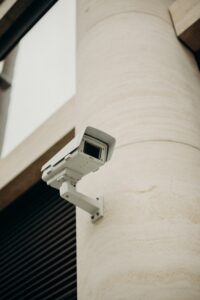
All the schools have CCTV cameras installed for ensuring safety and security. Emotional or psychosocial maltreatment hampers a child’s sense of personal safety and security. Schools should focus on providing the right ambience to nurture and develop a child. 

Safety in school transportation

As per CBSE guidelines, it is mandatory for schools to install GPS systems to ensure the safety of students in school transport. This too can enable schools to provide updates to parents about their children’s whereabouts. However, this is something that must be monitored regularly to check whether the drivers are sticking to their prescribed routes and following traffic rules. Any violation of speed limits or variance in routes should be investigated, resolved, and documented. Additionally, there should be a defined escalation matrix to address these violations.

Monitor Activities at School

Prudence should be applied in selecting activities in the school premises for monitoring. An understanding of the at-risk areas and creating a system to mitigate those risks can help in preventing unauthorized activity without creating an oppressive big brother environment.

Restrict Entry

Restricted access areas should be clearly defined and access should be managed both by architectural design and technology.
Ensuring safety and security in schools 2

Additional measures that can augment the system are:

  • Establish clear safety and security policies.
  • Assessing school processes from time to time.
  • The document, investigate and report to relevant personnel any suspicious incident at school
  • Mandatory carrying of ID cards.
  • Training on safety and security.
  • Install a central security system.
  • Issue access cards to restricted areas.

Security Personnel in Entrances and Exits

This is the first thing that we notice – the security personnel. Every effort must be made to prevent the school from turning into a heavily policed school. It is only then can one establish trust in the institution and its people. However, there are certain checkpoints that require the physical presence of security, particularly the entrance and exits. Also areas of restricted access where trespassers may be at risk of injury.

ID cards

An identity card can carry much more information. “Smart-ID Cards,” with in-built sensors can be leveraged with technology to keep parents informed of their children’s whereabouts.

Physical Safety of students 

It is important to keep the school premises safe and secure for all the students. The school building built should ensure the ’Life Safety’ of students and should be resilient to all kinds of hazards. School administration, teachers, and students should be well aware and prepared to respond to any kind of disaster or threat.

Filed Under: Designing Schools, Future Schools | Tagged With: safe school environment, safety and security, safety and security in schools, school security

1 Apr 2020 |

Schools in a Post Covid19 World

What will schools look like post Covd19? The Covid19 crisis has come upon us quite suddenly and most feel ill equipped to deal with it.  It’s incredible when backed up against a wall, we can think of ingenious ways of connecting with each other.

Fortunately over the last few years work from home as a concept has gained a lot of traction. Technology in its many different forms has been a key enabler that has led to this shift. So while the situation is bad a lot of work is still possible because of technology.

online-toolsMoodle, Google Classrooms have been around for a while but now classes are also via Zoom. These technologies were already gaining traction, but now there is more widespread adoption. The digital technology, media and information age that we are part of, had already ensured the presence of these tools.

Instead of the future of work, it is now the present of work, of our social lives and also of schools. Being in lock down, there is uncertainty in the timeline when our normal lives will be possible. Schools have seen that starting with training of teachers, to planning lessons and now conducting classes online. They have begun to deal with the situation.

There will be challenges, as there will be more dependence on the student driven learning, more engagement from the parents in being part of the child’s learning. Private schools are better geared towards these decisions, the government schools and the ones from the economically weaker sections will need to play catch up. But that does not mean we cannot begin to innovate. The teachers can account on greater tools to track, monitor (& analyse) progress of their students. Greater child centered learning.

project-based-learningProject based learning is well suited to this challenge. It will be interesting how teachers are able to channelize student curiosity to greater learning. Perhaps, we are already simulating their future workspaces. Given this scenario one expects pedagogies such as project based learning to become more robust in fulfilling the learning needs of students.
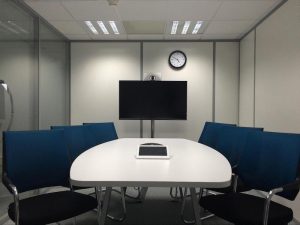
Classrooms need no longer be bound with geographies. It is about collaboration, imagine a child in Chennai collaborating on a project with children in China, US, France and UK. That would mean that there will also be a radical shift in design of our physical spaces – our classrooms, our schools and libraries. Not just open classrooms, small group rooms, large group rooms, conference rooms. Much like a modern day office? I would love to hear from educators and architects on how they envision this space.

remote-classroomsIn such scenarios it could bring the world closer together in seeking solutions; much like the current scenario where the entire world is trying to confront a global crisis. Sharing of experiences, solutions and project works will not only encourage a greater collaboration worldwide but also build cultural sensitivity and understanding.

Do share your thoughts on the future of schools, by responding to this survey link. Click Here

You could also write to us to share your thoughts: marketing@newtonschools.in

Filed Under: Designing Schools, Future Schools | Tagged With: after the lockdown, schools post covid19

14 Jan 2020 |

Importance of Good Acoustics in Schools

Good Acoustics

conference-roomWhen we speak, we push air from our lungs through the neck via the vocal cords, which in turn vibrate and create sound. The sound continues on via the nasal cavity and oral cavity, creating sound waves that are released into the room. These sound waves are received by someone’s ears via the outer ear to the inner ear, where they are converted into electrical impulses. These continue to the brain, where the receiver hears. What is heard is not just a voice, however, but also what the room does to the voice of the sender. If the speech is interesting, the receiver hopefully starts listening, and if the acoustical conditions around the speaker are good, you are likely to remember more of what is said.

The cost of noise in education – listening and retaining information

Noise creates a great cost in terms of education. A study found that German classrooms have an average sound level of 65 dB, which is high. If you view teaching as watering the garden, poor acoustics means that some of the water evaporates rather than gets received by the flowers. Listening becomes a challenge, and teachers and students need to repeat themselves to get heard and listened to. The fact that humans are not great listeners from the beginning makes it more difficult – we usually only retain 25% of what someone says.

What is a sound classroom environment?

classroomsTeachers and students have three wishes in relation to sound and noise in classrooms. They want:
  • Better speech perception. This is affected by the speaker’s voice and listener’s ears – and by the room acoustics. Good acoustics means that the voice can easily reach the listening ears, as the sound waves are direct and only pass the ears once; like they do in an outside environment. If you cannot go outside to teach, you can still optimise the internal environment to have improved acoustics. For example, you can place a bookcase in the classroom, fill it with binders, and then remove every other cover. This creates a diffusion effect similar to the one in the forest.
  • Better speaker comfort. Insert something that reflects sound above the speaker so he or she can hear and know that what is said can be heard by the receivers.
  • Less noise You cannot force children to be quiet, but by providing the right acoustic conditions in which to listen and learn, the teacher can focus on what matters: teaching.

Acoustic strategies – Five aspects you need to know

You need an understanding of the following five aspects to be able to create a good acoustic environment:

  1. What teaching method is used
  2. What technical devices are used
  3. What the building and rooms look like
  4. How the room is decorated
  5. Knowledge about the impact of noise on humans

The proof – The Essex Study

https://www.ecophon.com/en/knowledge/essex-study—good-acoustics-enable-effective-group-work-in-classrooms/

The Essex study (2012) stresses the importance of good acoustics in schools. The results showed that having acoustically treated rooms leads to:

  • Less vocal effort needed from teacher
  • Lower overall noise level (primarily for those with hearing impairment, but the situation was improved for all students)
  • Better signal/noise ratio
  • Better behaviour (students becoming quieter and behaving differently)
  • Better teaching and learning possibilities

Harshal Kolwankar
(Concept Development Manager) – Ecophon Group
Email: Harshal.kolwankar@saint-gobain.com
Contact No- +91 9869138449

https://www.acousticbulletin.com/

About Ecophon Group:

Ecophon Group develops, manufactures and markets acoustic products and systems for ceilings and walls. Used all over the world, our solutions meet the growing demand for good acoustics with the focus on offices, education, and health care premises. Ecophon contributes to a better working environment— wherever people work and communicate. The company is based in Sweden & it’s a part of the global Saint-Gobain Group www.ecophon.in

Filed Under: Designing Schools | Tagged With: Acoustics, Classroom design, Sound

17 Nov 2019 |

21st Century Classroom Furniture

school furniture While setting up a new school not enough effort is devoted to the selection of appropriate furniture. One suited to design & function. In a traditional school, it consists of a standard set of desks in a limited set of sizes. Progressive investors, who value open classrooms, understand the value of planned furniture. The lack of choices hampers their decision.

So what about furniture? Age appropriate and comfortable. While selecting products labelled ergonomic, it is important to understand how? How is the shape of the furniture suited to children or teachers? Children should be able to sit comfortably for long durations, able to see appropriate presentation/discussion areas. Furniture must be safe, no sharp edges, splinters, nails or spaces. Children injure themselves with these. Furniture manufacturers must use safe materials, paints, plastic. The decision makers must consider the certifications of the furniture manufacturer. Give preference to an accepted standards agency.

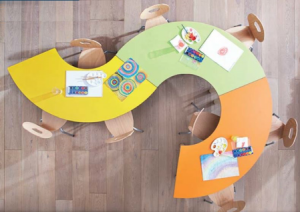
Classroom furniture is a teaching tool that allows the learning to be student-centered. Inquiry based learning, experiential learning or project based learning are pedagogies supported in a 21st century classroom. Furniture can also play a role in supporting innovative curricula. The furniture should be adaptable to varied layouts. Furniture that facilitates collaboration, communication, traditional discussions and presentation. It must be multi-function. The product brochures illustrate the various applications of the product in a classroom. Do those arrangements suit the specific curriculum plan for the school. Furniture can separate spaces, create corridors, niches and other informal spaces for study and discussions.

comfortable seatingOpen classrooms serve as multi use spaces. They are expandable to create larger areas through movable partitions and glass walls. They suit traditional lecture style classrooms and modern group activities. Likewise furniture should also be easily movable. Some of it should be movable by the children themselves. Modular so that you can add more without any aesthetic changes. E.g. it should be possible to arrange the desks for a group discussion or for individual work.

Projects or inquiries are an integral part of the innovative classroom. Students need display areas and storage for these. This must be of 2 types, one that is accessible by students and one that has restricted access. This requires close collaboration & planning with the class teachers or the curriculum head. Furniture can help group cohesion, communication and collaboration.

The best designed and safe furniture is available from several manufacturers in Europe. Most come highly recommended. We believe in them. They meet high standards of quality and have delivered for several years. In doing so, they have often backed new designs with research to have a sort of mastery over their products. In general, the workmanship is of a high quality and these come with a warranty of performance. Cost can often be a constraint. Suppliers are provide better rates with larger orders. This may not always be possible.

Often the next resort is China. Suppliers who have a wide array of products that also suit the school needs. They may not have the design history but have delivered over time. This is also a viable solution. Manufacturers in China deal in large volumes. They have greater experience and better craftsmanship. My advice. If you cannot find a local vendor who can support you, travel to China yourself. Do not pick the cheapest option available.

The first concern should be of the materials used in manufacturing them. The best way to check this would be to check the standards they meet. Second, are there moving parts that will need replacement or repair? Will they be available to you locally at reasonable prices? What is the cost of the product after considering shipping & freight? Taking care of these concerns should ensure the right decision.

There are local manufacturers who produce reasonable quality furniture. Our clients have had varied experiences. Some have easily met their requirements at reasonable costs. Others have been somewhat satisfied, others found them too expensive. The proximity of the local manufacturer and the higher engagement helps. Clients sometimes are not able to find all their solutions in one place. There is flexibility in dealing with local manufacturers. Less concerns of the availability of local parts and servicing.
The last option is of local fabricators to replicate the furniture design. This is acceptable for simple cupboards or lockers but not for specialized furniture. The first concern is of craftsmanship, it is not easy to get the finish one gets in a factory produced goods. There is a limit to the guarantee a craftsman can provide. It’s difficult to have standardized parts. Each servicing or repair option will be a unique request. Key intricacies of the product design can lost. And as a result the functionality. The substitute material used is manufacture can influence the outcome. It is more difficult to set a budget at the outset. On occasion this can become the most expensive option. We recommend this option to our clients when there is control on input material, design and cost .

We understand that based on the situation different options will suit the clients. We ensure that the clients weigh all these options. That their frame of reference has the stakeholder requirements and the school curriculum.

A classroom that fulfils these criteria, blends with the school design concept and has colours that helps children channel their attention is one that is for a 21st century school.

Filed Under: Designing Schools, Future Schools | Tagged With: china school furniture import, modern school furniture, new school furniture, school design, school furniture

12 Jun 2019 |

What should you expect from a school feasibility report?

school-report

We advise clients to conduct a feasibility study when they approach us for support to set up a school. At a high level, it is a decision enabler that builds an understanding of the viability of the project, the challenges, the likely outcomes and alternatives to undertaking that particular project. Such findings can be intuitive but when backed by study and research, it can increase the probability of a successful project and decrease the probability of missteps. You can reassess your commitment to the project, before allocating significant resources to the project.

A project feasibility report is not a detailed project report (DPR), that lays out everything that must be done to execute the project. A DPR should be undertaken only once you are ready to commit to the project. When seeking a project feasibility report, we advise you to have a certain set of expectations.

You must use the feasibility report to scrutinize the practicality of the school project in the identified location. As consultants, we lay out the options and factors systematically assessing the school project on a number of attainability factors. A feasibility study strives to objectively, accurately and reasonably expose the strengths and weaknesses of the school project. Doing this, you may be able to minimize your biases in the project. When laid out clearly before you, you should be able to evaluate the options, commit to or withdraw from the project with confidence.

For greenfield school projects, nature of information that you should expect are

  • Site selection
    • Are any local factors likely to influence the cost of construction?
    • What is the nature of use land adjacent or in close proximity to the land?
    • Are resources such as water and electricity available reliably and reasonably?
    • Is there any local perception on the acquisition of the land?
  • Organization options
    • Whether the site is accessible for talent?
    • Can the area be serviced by support staff locally? Or are there options to outsource the support services to external agencies?
    • Will residential accommodation be reasonably available for teachers, facilities and support staff? Will it be required?
    • Market assessment

o   What is the competition? What is the target audience for the school?

o   What is the perception of the target audience of the school concept?

o   Are there any expectations of the parents?

o   Is there a match between targeted fees and parents willingness to pay?

  • Legal / Administrative scenario

o   What are the policy trends? Or guidance frameworks?

o   How can they impact the project?

  • Alternatives available

o   What are the alternatives to the school concept in the given location?

o   What are the alternatives to the school location?

A well-designed feasibility study must provide a background to the project and evaluate its sensibleness. It must provide all the inputs required to choose to further or reject a proposal. Usually, feasibility studies precede technical growth and projectexecution.  They can also lead to further marketing studies to build a case before investors or banks.

Filed Under: Designing Schools | Tagged With: feasibility report, project report, school feasibility report, school project report

  • « Go to Previous Page
  • Page 1
  • Page 2
  • Page 3
  • Page 4
  • Go to Next Page »

Primary Sidebar

The Newton Schools Blog

With over 25 years of working with schools, Newton has gained substantial insights into every aspect of planning, creating and operating schools - be it a preschool, a large boarding school or a innovative K-12 school in a city. We would like to share these insights and our experience with edu-entrpreneurs, educators and all our partners.

Signup for the NS Blog

Loading

Search

Contact Us


Phone

+91 87663 05479

Email

mail [at] newtonschools.in

About Us

As consultants for school projects in India, Newton Schools is focused on perfecting learning environments and creating amazing schools for children. We have executed several greenfield school projects end-to-end. We are based in Gurugram, India – the new city that has seen a large number of progressive and innovative new schools constructed over the past 15 years.

Know More

Quick Links

Home
About Us
The need for 21st century schools
Creating new schools
School consultants
Projects Executed

Signup for the Newton Schools Blog

The NS Blog offers insights gained over the past 25 years in planning, creating and operating schools. Signup for free here:

Loading

· Copyright © 2026 · NEWTON SCHOOLS Our Businesses: · NEWTON SERVICES